

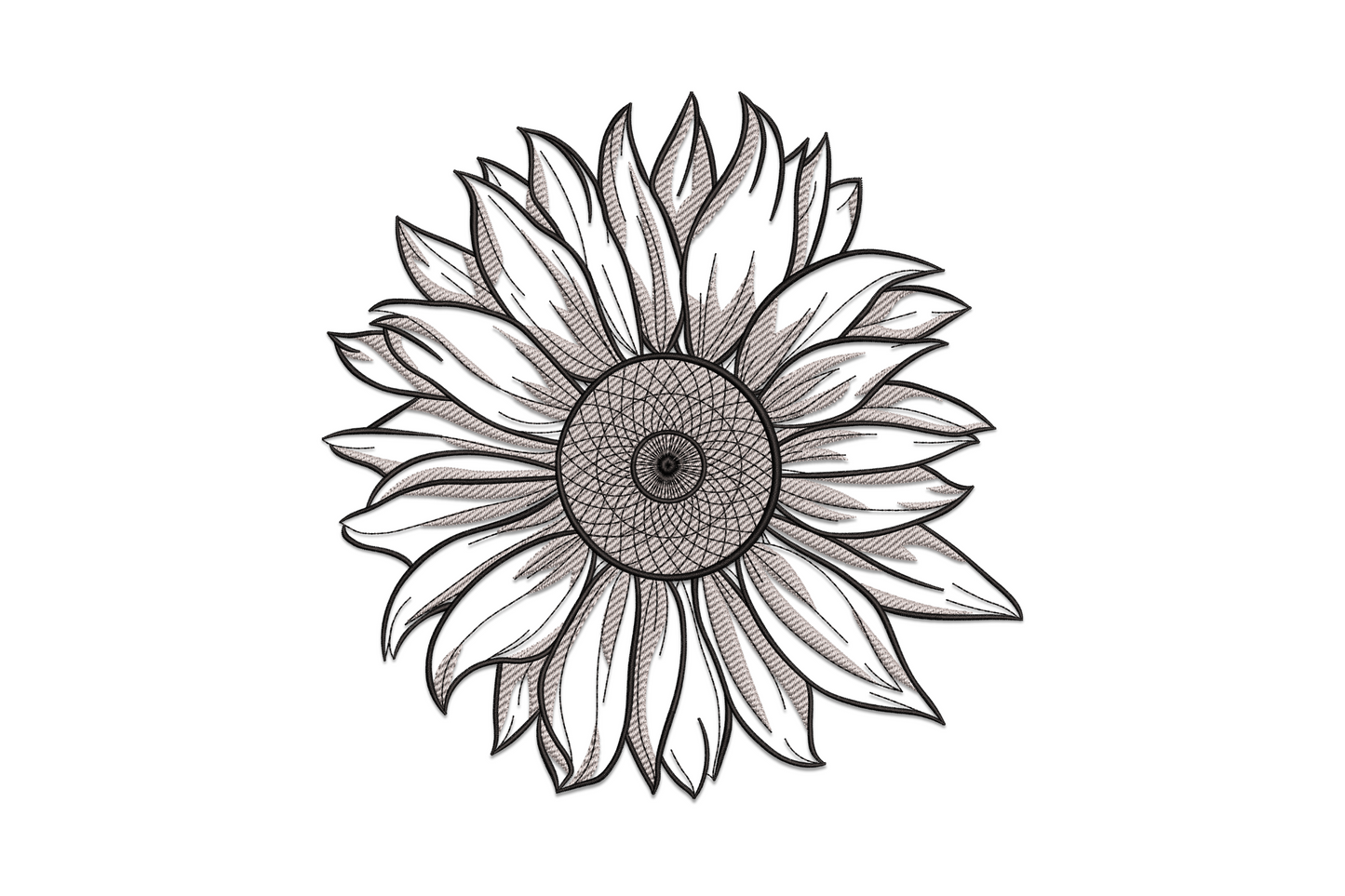
Its a sunflower done in that old engraving style, the kind you'd find in a botanical atlas from 1880 something. No colour, just black and grey, and it works harder for it. The centre disc has a dense crosshatch grid that builds up into a dark bullseye at the core. Each petal fans out from there with tight parallel lines running its length, so the whole flower reads like it came off a copper plate, not a machine.
And its not flat either. The petals sit in two clear rows, inner and outer, offset from each other so you get full layered depth without it going muddy. Outer petals catch more line density at the tips, which pulls your eye around the bloom. Dark tatami fill on the disc stitches firmer than the petals, so theres a real contrast in texture when you run your finger across it, the disc almost feels rigid against the softer petal fill.
Density's 627 stitches per square inch, so its one that takes its time. Biggest size runs close to 35k stitches at 7.43 by 7.51 inches, smallest is 3.47 by 3.51. Use a medium-weight cutaway on woven fabric. Add a lightweight tearaway topping on anything with a nap so the fine crosshatch lines stay crisp on the surface, dont skip that step or the crosshatch legs blur into the fibres and you lose the whole vintage print quality. A customer last spring tried this without topping on a velvet tote and the disc lines completely disappeared, sent me a photo, wasnt pretty. Slow the machine speed down on the dense disc section too, the tatami stitch count there is heavy.
Black or dark charcoal thread on white or cream fabric is the obvious move and it really sings that way. I've also seen it done in sepia on natural linen, which gives it a proper antique field-guide feel. Pick a high-contrast combo and youll get your money's worth. Holler at me if a thread shade isnt working out and Ill point you at the right thread.
What people are using this design for
A starting point. The design works for plenty more than just this list, this is what folks have stitched it onto most.
- Tote bag centre panel in black on cream canvasCentre the large size on a oatmeal canvas tote and it reads like a botanical print you'd find in an art-supply shop window
- Denim jacket back yoke as a botanical statement pieceSew the 6-in on a denim panel back panel above the waist seam for a piece that stops people on the street
- Linen tea towel with a vintage kitchen feelPop the medium on a white linen tea towel and pair it with a matching herb-print set for a kitchen gift set
- Cushion cover in black thread on natural undyed linenPlace the 7-inch on a natural undyed linen cushion and it looks like a pressed botanical specimen behind glass
- Apron bib detail for a farmers-market aestheticEmbroider the 5-inch on an apron bib for someone who sells at markets or runs a flower stall
- Cotton tee chest print for botanical fashionUse the 4-inch on a white cotton tee chest pocket area for a clean botanical fashion look
- Framed hoop art in a botanical print styleStitch up the large in a plain hoop, frame it and hang it in a reading nook or studio
- Book bag or library tote for plant loversAdd the medium to a cotton book bag for a student or someone who frequents the library and loves plants
Dimensions
5 sizes included. Stitch counts shown for the largest colorway.
| Size (in) | Stitches |
|---|---|
| 3.47 × 3.51 in | 15,522 |
| 4.46 × 4.51 in | 19,987 |
| 5.45 × 5.51 in | 24,733 |
| 6.44 × 6.51 in | 29,733 |
| 7.43 × 7.51 in | 34,959 |
Files & Formats
Eight machine formats included in one zip. Whichever your machine reads, its in the pack.


Plus a color chart for thread matching. See full format guide.
Reviews
No reviews yet for this design. Be the first to share your make once you have stitched it. Tag us on Instagram and we will feature your work.
You may also like
Other designs from this collection you might love

Blue Flower Fairy Embroidery Design, Instant Do...

Cute Baby Girl Clothes Embroidery Design, Machi...

Cherry Blossom Branch Embroidery Design, Spring...

Frog Love Embroidery Design, Cute Valentine Fro...

Cat on Moon Embroidery Design, Dreamy Night Sky...

Your Opinion Is Not Part of the Recipe Embroide...

Fustergluck Kitchen Rooster Embroidery Design, ...

Spring Floral Gnome Embroidery Design, Machine ...

Bee Farm Raw Honey Embroidery Design, Machine E...

Coastal Lighthouse Embroidery Design, Machine E...

Red Tulip Embroidery Design, Machine Embroidery...

Raven on Tree Embroidery Design, Machine Embroi...
Browse by category
Pick a theme, find the perfect design for your next project




About the artist
Reyazul Masud Riham, hand-drawing every design on this site
Every design on Re Embroidery is hand-digitized by one person. Each file gets sketched, color-matched, and stitch-tested on real fabric before it earns a place in the shop. No team. No auto-conversion from images. Just slow, deliberate work, sometimes three or four days per design.
That's the joy I work for.
The hard part is finding my designs re-uploaded and resold elsewhere. So when you buy from Re Embroidery, you're paying one real person for the file you're about to download. That matters.
