

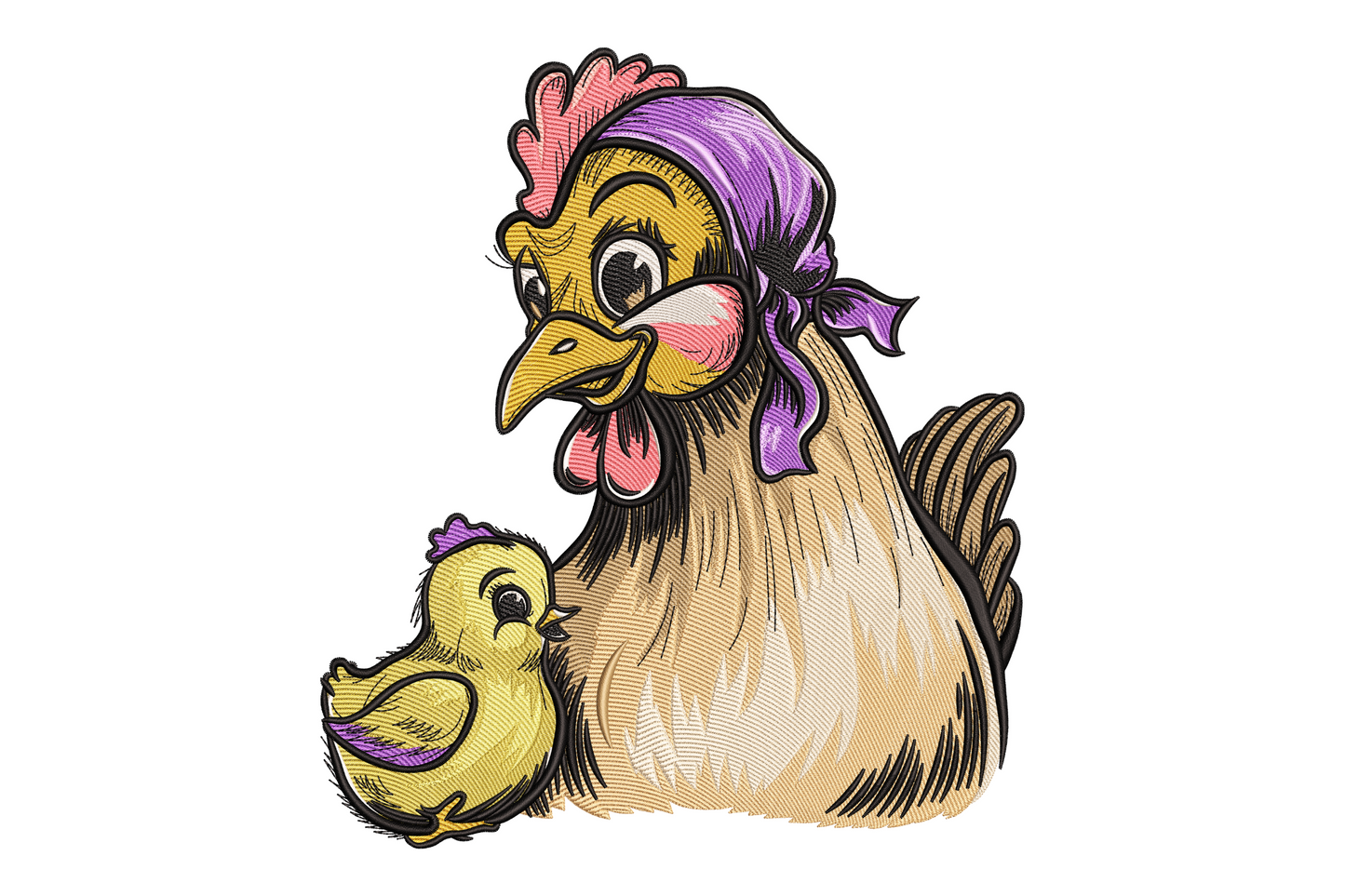
Its a mother hen with a single chick pressed right against her leg, the way they do when something spooks them. The hen takes up most of the frame, body in rust brown with the feathers done in short directional stitching that fans from the quill line, not a flat fill. The comb and wattle are satin in scarlet, bright against the warm body, and the underside feathers lighten to cream. The chick is compact, mostly butter yellow with an orange beak, and sits lower in the composition so the size difference reads clearly.
Nine sizes from 4.51 inches wide at the smallest up to 8.51 inches at the largest. Stitch counts go from 34,820 all the way to 77,374, which is alot of thread at the top end. Fourteen colour regions total with the full sequence already set up in Wilcom. I went back through the underlay settings twice because the feather zones need proper column underlay or the satin sections on the wattle lift off stretchy fabric and youll lose that sharp red edge. Density runs at 1,216 so use a firm cutaway stabiliser, not tear-away, the pull count is too high for tear-away to handle cleanly.
Best fabric for this is a cream or off-white tea towel, flour sack weight cotton, where the rust and scarlet really pop. Its also worked well on a tote canvas and on an apron bib. And the 8.51-inch version at full scale on a natural linen panel looks like a proper farmhouse print, I had a customer frame one in a 10-inch hoop and hang it in a kitchen last spring. Stitch the smaller sizes on a shirt pocket or a zip pouch and the detail still reads at arm length because the directional feather fill catches the light differently to plain satin. Dont be surprised by the prep time on the colour sequence, it runs in the right build order so theres no reordering needed.
Bobbin tension matters with this one, keep it snug and consistent or you get draw-in on the wide satin sections of the comb. The 14-colour load takes abit of setup but once its hooped and running it goes straight through without backtrack changes mid-stitch.
What people are using this design for
A starting point. The design works for plenty more than just this list, this is what folks have stitched it onto most.
- Tea towel or flour sack kitchen clothA cream tea towel at 6-7 inches wide shows off the rust and scarlet colour contrast well against the neutral ground.
- Apron bib chest placementThe apron bib placement at 5-6 inches sits high enough to be visible without overcrowding the front panel.
- Framed hoop art for a farmhouse kitchenFramed in a 10-inch hoop the 8.51-inch version fills the circle and the directional feather stitching reads up close.
- Canvas tote bag for a farmers marketCanvas tote at 6 inches centred below the handle bar gives the farmhouse illustration a clean placement.
- Kids room pillow with farm animal themeKids pillow cover at 5 inches lets the chick scale feel proportionate and the bright scarlet comb is eye-catching for children.
- Quilting block or fabric panelUsed as a quilting panel block the rectangular composition fits standard sashing without extra trimming.
- Shirt or blouse front pocket accentThe 4.51-inch size on a shirt front pocket comes in under the standard pocket height with a few millimetres to spare.
Dimensions
9 sizes included. Stitch counts shown for the largest colorway.
| Size (in) | Stitches |
|---|---|
| 4.51 × 3.96 in | 34,820 |
| 5.01 × 4.40 in | 39,402 |
| 5.51 × 4.84 in | 44,186 |
| 6.01 × 5.28 in | 49,206 |
| 6.51 × 5.72 in | 54,697 |
| 7.01 × 6.16 in | 60,069 |
| 7.51 × 6.60 in | 65,589 |
| 8.01 × 7.04 in | 71,444 |
| 8.51 × 7.48 in | 77,374 |
Files & Formats
Eight machine formats included in one zip. Whichever your machine reads, its in the pack.


Plus a color chart for thread matching. See full format guide.
Reviews
No reviews yet for this design. Be the first to share your make once you have stitched it. Tag us on Instagram and we will feature your work.
You may also like
Other designs from this collection you might love

Blue Flower Fairy Embroidery Design, Instant Do...

Cute Baby Girl Clothes Embroidery Design, Machi...

Cherry Blossom Branch Embroidery Design, Spring...

Frog Love Embroidery Design, Cute Valentine Fro...

Cat on Moon Embroidery Design, Dreamy Night Sky...

Your Opinion Is Not Part of the Recipe Embroide...

Fustergluck Kitchen Rooster Embroidery Design, ...

Spring Floral Gnome Embroidery Design, Machine ...

Bee Farm Raw Honey Embroidery Design, Machine E...

Coastal Lighthouse Embroidery Design, Machine E...

Red Tulip Embroidery Design, Machine Embroidery...

Raven on Tree Embroidery Design, Machine Embroi...
Browse by category
Pick a theme, find the perfect design for your next project




About the artist
Reyazul Masud Riham, hand-drawing every design on this site
Every design on Re Embroidery is hand-digitized by one person. Each file gets sketched, color-matched, and stitch-tested on real fabric before it earns a place in the shop. No team. No auto-conversion from images. Just slow, deliberate work, sometimes three or four days per design.
That's the joy I work for.
The hard part is finding my designs re-uploaded and resold elsewhere. So when you buy from Re Embroidery, you're paying one real person for the file you're about to download. That matters.
