

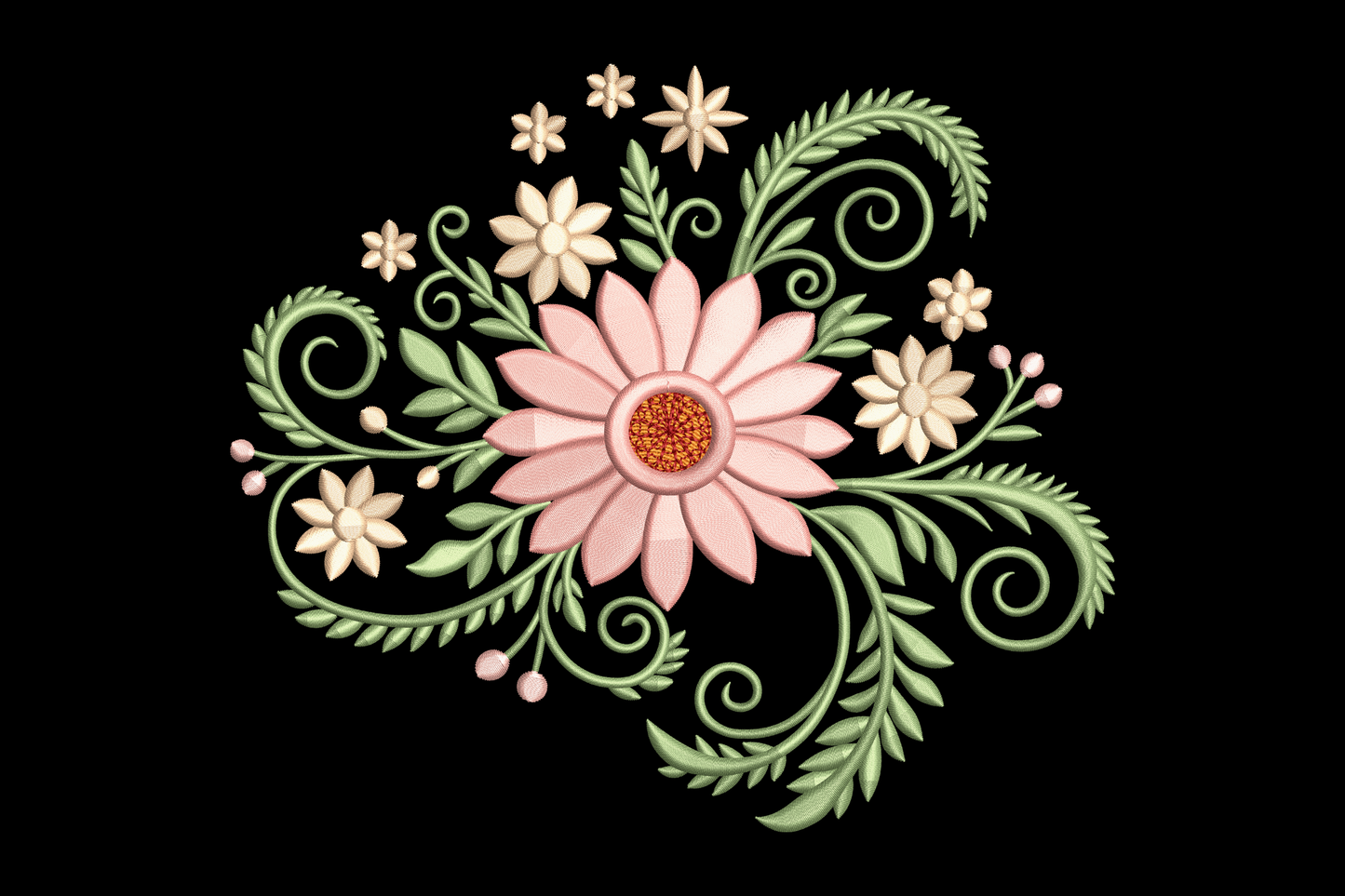
Linen napkins were honestly the first thing I thought of when I finished digitising this one. That big central bloom sits right in the corner of a dinner napkin and the swirling vine arms fan out so naturally across the fabric, like the design was made for the weave. Its a full ornate arrangement, so theres a lot going on: a large pink daisy-style flower with layered satin petals and a burnt-orange tatami center, then cream ivory accent flowers on curling green stems, and lil berry buds dotted between. Alot of movement for a botanical.
Stitch density on this sits around 640, which means the petals come out raised and really dimensional rather than flat. I use directional satin runs on each petal layer so they catch light differently at different angles, and I sew the swirl vines in satin too so they get that smooth ribbon-like finish. Hoop a cotton twill or a linen with a cutaway stabiliser underneath and the whole thing lands cleanly. On stretchy jersey or fleece you'd want a heavier cutaway plus a layer of topping so the satin lines dont sink into the pile.
Somebody who cross-stitches by hand and recently switched to machine embroidery ordered this one last week and said it was the first design that actually looked like something she'd stitch herself. I get that. Theres nothing modern or minimal about it. Its old-fashioned botanical illustration energy, the kind you'd find on a vintage tea tin, and I think thats why it works on so many different fabrics and projects.
The 5.5 inch fits a quilt block nicely if you're doing a floral sampler. Pop it on plain white cotton and give it a stabiliser, the blush pink reads almost watercolour-soft once the thread settles. Pair it with simpler companion designs if you dont want it competing, because at 31,273 stitches in the largest size its gonna be the focal point wherever you put it. Stitch the vine tendrils before the center bloom so your underlay thread tension stays consistent across the full design area.
Skip the water-soluble topping on woven fabrics, you genuinely dont need it and it can leave residue in the open-stitch areas between the satin swirls. Use a 75/11 embroidery needle on lighter canvas or a 90/14 on heavier denim. Iron the back on low heat to set the bobbin threads flat after you remove it from the hoop.
Get in touch if your hoop fights the design.
What people are using this design for
A starting point. The design works for plenty more than just this list, this is what folks have stitched it onto most.
- Linen dinner napkin cornerHonestly my favourite spot for this one, the vine arms follow the napkin corner and fill it without overcrowding.
- Quilt block centerThe 5.5 inch drops into a quilt block with room for a seam allowance on plain white cotton.
- Tote bag front panelCentres nicely on a canvas tote with the bloom at mid-chest height and swirls reaching toward the handles.
- Denim jacket back yokeBig enough at 7.5 inch to anchor a back yoke on a denim jacket without looking lost across that much fabric.
- Cotton pillowcase borderRun it along the open end of a pillowcase on cream cotton so the blush pink sits against the white weave.
- Framed hoop artHooped on natural linen and left in the hoop, this one frames itself, no extra mounting needed.
- Baby blanket cornerThe 3.5 inch tucks into a fleece blanket corner without pulling the fabric, use a heavier cutaway here.
- Table runner accentRepeat two or three times along a table runner on ivory twill for a formal botanical effect.
Dimensions
5 sizes included. Stitch counts shown for the largest colorway.
| Size (in) | Stitches |
|---|---|
| 3.50 × 3.04 in | 16,114 |
| 4.50 × 3.91 in | 19,883 |
| 5.50 × 4.78 in | 23,704 |
| 6.50 × 5.65 in | 27,421 |
| 7.50 × 6.52 in | 31,273 |
Files & Formats
Eight machine formats included in one zip. Whichever your machine reads, its in the pack.


Plus a color chart for thread matching. See full format guide.
Reviews
No reviews yet for this design. Be the first to share your make once you have stitched it. Tag us on Instagram and we will feature your work.
You may also like
Other designs from this collection you might love

Blue Flower Fairy Embroidery Design, Instant Do...

Cute Baby Girl Clothes Embroidery Design, Machi...

Cherry Blossom Branch Embroidery Design, Spring...

Frog Love Embroidery Design, Cute Valentine Fro...

Cat on Moon Embroidery Design, Dreamy Night Sky...

Your Opinion Is Not Part of the Recipe Embroide...

Fustergluck Kitchen Rooster Embroidery Design, ...

Spring Floral Gnome Embroidery Design, Machine ...

Bee Farm Raw Honey Embroidery Design, Machine E...

Coastal Lighthouse Embroidery Design, Machine E...

Red Tulip Embroidery Design, Machine Embroidery...

Raven on Tree Embroidery Design, Machine Embroi...
Browse by category
Pick a theme, find the perfect design for your next project



About the artist
Reyazul Masud Riham, hand-drawing every design on this site
Every design on Re Embroidery is hand-digitized by one person. Each file gets sketched, color-matched, and stitch-tested on real fabric before it earns a place in the shop. No team. No auto-conversion from images. Just slow, deliberate work, sometimes three or four days per design.
That's the joy I work for.
The hard part is finding my designs re-uploaded and resold elsewhere. So when you buy from Re Embroidery, you're paying one real person for the file you're about to download. That matters.
