

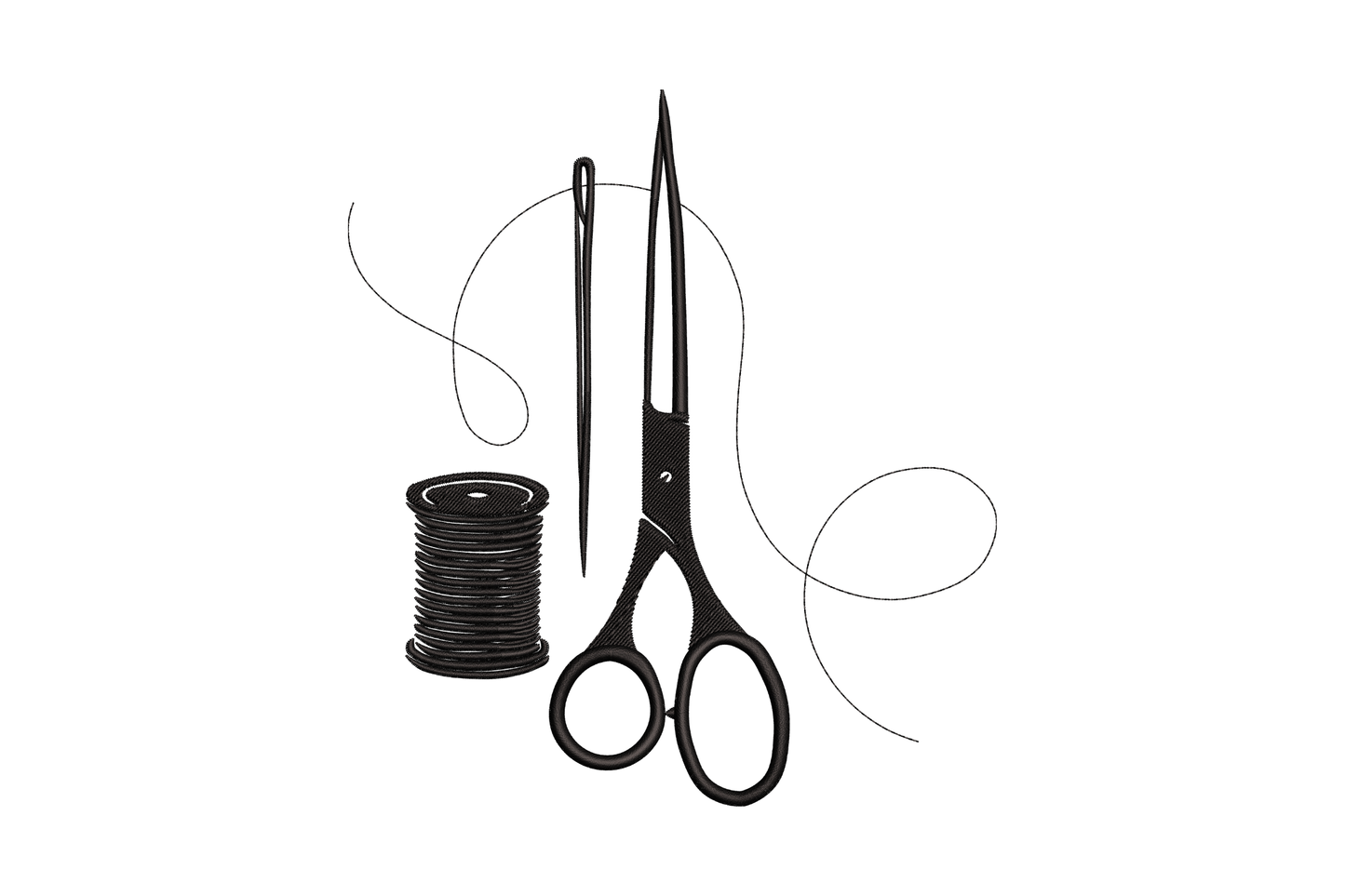
Three things: needle, scissors, thread spool. Thats it. No background, no extra elements, just the three tools most people actually reach for every session, arranged like someone set them down on a table mid-project. The needle sits slightly forward, thread arcing off the top in a loose curve. The scissors tuck behind at an angle. The spool anchors the bottom left. It reads like a pen sketch, not a technical illustration.
Single black thread, zero colour changes, density at 238 which is on the lighter side for black, meaning the satin lines stay crisp and defined without becoming stiff or card-like on the fabric. Its genuinely light for a design this size. Stitch count runs 5,457 at the smallest 3.51 x 3.17-inch size up to 12,146 at 7.51 x 6.79 inches. Five sizes total. Run this on a lightweight cutaway or even a firm tearaway if your base fabric is a tightly woven cotton, at this density level the backing doesnt need to be heavy.
Good fabric for this one is white pique cotton or navy canvas, because the open composition means the background reads as part of the design. Avoid busy printed fabric, the outline-only style needs a plain base to land correctly, and it wont read on a floral background. Use a 60-weight bobbin thread if youve got it. At 238 density the bobbin pulls through more than usual and a thin bobbin keeps the back neat without bulking.
A customer wrote me last month asking if this worked on a denim jacket. Yep, it does, stitch the 5.5-inch file on a firm tearaway, hoop the rear jacket piece flat before you've sewn the jacket together, and it centres nicely between the shoulder blades. Dont hoop the finished jacket, it'll pucker around the seams something awful. Theyll thank you for this tip.
What people are using this design for
A starting point. The design works for plenty more than just this list, this is what folks have stitched it onto most.
- White pique apron with the 7.5-inch version as a bold craft room statement pieceHoop the apron bib flat with medium cutaway, stitch the large 7.51-inch file centred -- the light density means the design drapes naturally when the apron is worn.
- Denim jacket back panel for a crafter who wears their hobby literallyHoop the back panel of an unassembled jacket with firm tearaway, stitch the 5.5-inch file, then construct the jacket after pressing -- avoids seam distortion.
- Canvas zip project bag for someone who takes their sewing kit everywhereStitch on the front face of a pre-cut canvas zip pouch panel before sewing the bag, cutaway backing, press after stitching so the outlines lie flat.
- Craft room wall hoop in a 10-inch natural wood frame with undyed cottonMount on natural undyed cotton in a 10-inch wooden hoop, leave lightly pulled in the frame -- the open design looks intentional at this scale.
- Birthday gift card holder -- stitched on a small linen envelope and paired with a gift cardCut a 4x5-inch piece of linen, stitch the 3.5-inch file, fold into an envelope shape after pressing, stitch the edges closed -- pairs with any craft store gift card.
- Plain flour-sack kitchen towel that doubles as a sewing notions wrapperHoop a flour-sack towel in the lower third with tearaway backing, stitch the 4.5-inch mid-size, press flat -- the tool cluster doubles as a wrapping decoration when folded around a box of thread.
Dimensions
5 sizes included. Stitch counts shown for the largest colorway.
| Size (in) | Stitches |
|---|---|
| 3.51 × 3.17 in | 5,457 |
| 4.51 × 4.07 in | 7,032 |
| 5.51 × 4.98 in | 8,646 |
| 6.51 × 5.88 in | 10,331 |
| 7.51 × 6.79 in | 12,146 |
Files & Formats
Eight machine formats included in one zip. Whichever your machine reads, its in the pack.


Plus a color chart for thread matching. See full format guide.
Reviews
No reviews yet for this design. Be the first to share your make once you have stitched it. Tag us on Instagram and we will feature your work.
You may also like
Other designs from this collection you might love

Blue Flower Fairy Embroidery Design, Instant Do...

Cute Baby Girl Clothes Embroidery Design, Machi...

Cherry Blossom Branch Embroidery Design, Spring...

Frog Love Embroidery Design, Cute Valentine Fro...

Cat on Moon Embroidery Design, Dreamy Night Sky...

Your Opinion Is Not Part of the Recipe Embroide...

Fustergluck Kitchen Rooster Embroidery Design, ...

Spring Floral Gnome Embroidery Design, Machine ...

Bee Farm Raw Honey Embroidery Design, Machine E...

Coastal Lighthouse Embroidery Design, Machine E...

Red Tulip Embroidery Design, Machine Embroidery...

Raven on Tree Embroidery Design, Machine Embroi...
Browse by category
Pick a theme, find the perfect design for your next project




About the artist
Reyazul Masud Riham, hand-drawing every design on this site
Every design on Re Embroidery is hand-digitized by one person. Each file gets sketched, color-matched, and stitch-tested on real fabric before it earns a place in the shop. No team. No auto-conversion from images. Just slow, deliberate work, sometimes three or four days per design.
That's the joy I work for.
The hard part is finding my designs re-uploaded and resold elsewhere. So when you buy from Re Embroidery, you're paying one real person for the file you're about to download. That matters.
